Bagasse vs Bamboo Tableware – Which Is the Better Choice for Sustainable Dining?
Why Compare Bagasse and Bamboo?
Across Europe, North America, and the Middle East, businesses are under pressure to replace single-use plastics with sustainable alternatives. Two of the most popular materials that distributors, importers, and hospitality groups explore are bagasse and bamboo.
Bagasse Tableware – Turning Agricultural Waste Into Scalable Solutions
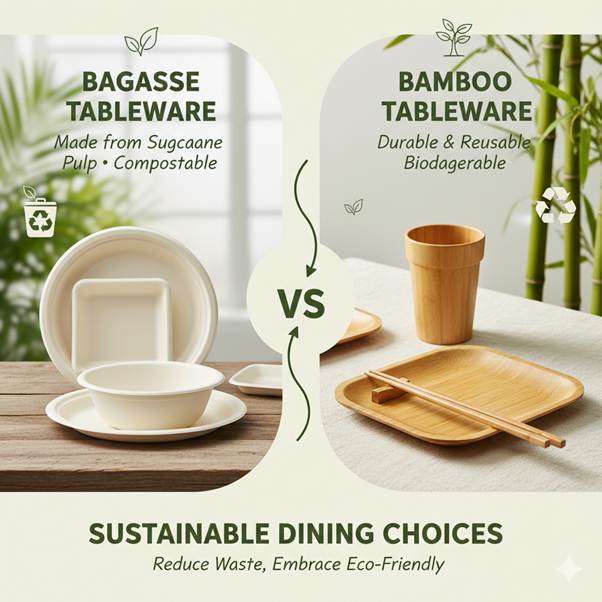
Bagasse is the fibrous residue of sugarcane, and in India — one of the world’s largest sugarcane producers — it is available in abundance. Instead of being discarded or burned, this byproduct is upcycled into 100% compostable tableware.
Key benefits for buyers:
- True Circular Economy Product → made from waste, returns to soil within months.
- Heat & Oil Resistant → suitable for hot food, catering, and delivery.
- Export-Ready Supply → India’s large-scale bagasse production ensures competitive pricing for international buyers.
- Cost-Effective in Bulk → affordable compared to bamboo or wooden disposables.
Bamboo Tableware – Premium Appeal, Practical Limitations
Bamboo has earned global attention as a sustainable resource. While visually appealing, it has fundamental limitations when used as disposable tableware:
- Costly → Bamboo processing is labor-intensive, making it expensive for bulk buyers.
- Not Always Compostable → Many bamboo products are laminated or mixed with plastic binders.
- Limited Scalability → Harvesting bamboo at scale strains resources; supply cannot compete with agricultural byproducts like bagasse.
- Perceived Premium Only → Works for luxury dining or boutique branding, but not for mainstream export markets.
Bagasse vs Bamboo – A Practical Business Comparison
| Factor | Bagasse Tableware ✅ | Bamboo Tableware ❌ |
| Raw Material | Sugarcane waste (abundant, renewable) | Harvested bamboo (resource-intensive) |
| Sustainability | Compostable, true circular economy | Often greenwashed, not always compostable |
| Cost Efficiency | Affordable at export scale | High cost, niche use |
| Bulk Supply | Easy to scale in India for exports | Limited scalability |
| Target Market | Food service, catering, hospitality, retail | Premium/luxury only |
👉 The verdict is clear: bagasse is the scalable, sustainable, and export-ready choice.
Why International Buyers Prefer Bagasse for Export Supply
Foreign buyers, wholesalers, and distributors don’t just need an eco-friendly product — they need a supply chain that performs at scale.
Bagasse provides:
- Predictable raw material flow → backed by India’s sugarcane industry.
- Lower landed cost compared to bamboo imports.
- Flexibility in design → plates, bowls, trays, clamshells, and custom branding.
- Compliance with EU & US regulations → making it safe for global retail and catering chains.
This is why international distributors increasingly switch from bamboo to bagasse — it’s the only material that makes sense for large-scale food service supply chains.
Greennest Earthware – Your Trusted Export Partner
At Greennest Earthware, we don’t just manufacture tableware; we build reliable export partnerships.
✔ Scale: Bulk supply capability to meet container-level demand.
✔ Export Packaging: Ready for international logistics and private label needs.
✔ Pricing: Competitive rates without compromising on quality.
✔ Philosophy: No Future Without Nature — sustainability at the core of our business.
For importers, wholesalers, and hospitality distributors, bagasse isn’t just a product — it’s a business advantage when sourced from the right partner.
Conclusion – Bagasse Is the Smarter Choice for Global Buyers
While bamboo has its place in boutique dining, bagasse is the only material that balances sustainability, cost, and scalability for international trade.
That’s why buyers across the Middle East, Europe, and North America rely on Indian exporters like Greennest Earthware to deliver eco-friendly, export-ready bagasse tableware.
👉 Looking for a trusted supplier? Contact us today: info@greennestearthware.com | 🌐 www.greennestearthware.com